Cheap Gonadorelin Will Cost You More Than Money
This isn’t a lecture. If you’ve already made up your mind about getting gonadorelin, whether that’s to keep your testicles working while you’re on TRT or for some other reason, chances are you’ve typed “where to buy gonadorelin” into a search bar at some point this week. Fair enough. That’s a real question, and it deserves a real answer, not a scare tactic and not a sales pitch.
Here’s the answer nobody wants to hear because it sounds like a lecture, except it isn’t one: the fastest, cheapest source is usually the one that puts you at the most risk, both to your wallet and to your endocrine system. This drug punishes guesswork in a way a lot of peptides don’t. So let’s walk through what it actually does, what happens if you get the sourcing wrong, and what the safer floor looks like if you’re going to do this regardless of what I say.
What you’re actually injecting
Gonadorelin is a synthetic copy of GnRH, gonadotropin-releasing hormone, the same signal your hypothalamus already sends out in pulses to keep your testes making testosterone and sperm. It works one rung up the ladder from HCG, at the pituitary instead of the testis directly, which is part of why people started reaching for it when HCG got harder to find.
Here’s the part that changes everything about how you should think about sourcing: this hormone only does its job in pulses. Flood your system with it continuously and you don’t stimulate anything, you shut the whole axis down. That’s not a side note, it’s the same mechanism doctors use deliberately to suppress hormones in prostate cancer treatment. So the question of who’s controlling your dose and timing isn’t paperwork. It’s the difference between the drug working and the drug doing the opposite of what you want.
See also: smart business digital solutions
Does the science actually back it up?
Mostly yes, with an asterisk you should know about.
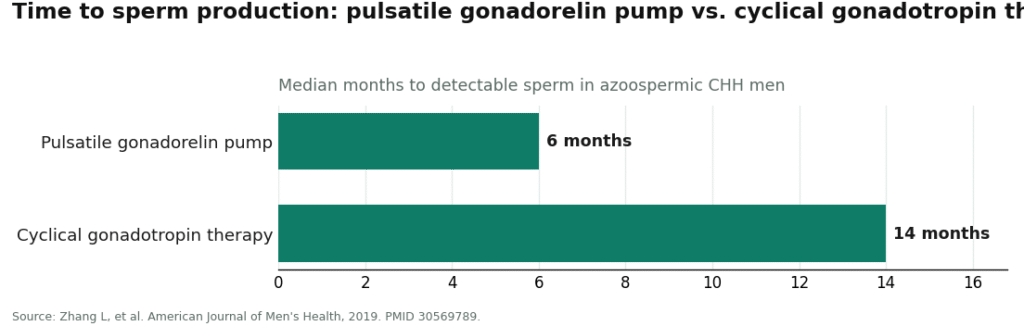
The best data comes from men with congenital hypogonadotropic hypogonadism (CHH), guys whose bodies never made their own GnRH signal to begin with. A 2025 study followed 54 of these men on a subcutaneous pulsatile GnRH pump and found testosterone climbing from a baseline around 48 ng/dL up to roughly 361 ng/dL after a year, with sperm showing up in about 79 percent of the men who gave samples, and a handful of natural pregnancies along the way [1]. Separately, a 2019 study found the pulsatile pump route got these men producing sperm faster than the older cyclical gonadotropin approach, a median of about 6 months versus 14, with similar success rates overall [3].
Now the caveat that matters if you’re the kind of person who reads past the marketing: a 2021 meta-analysis pooling 8 studies and 420 patients found pulsatile GnRH beat gonadotropin therapy on speed and fewer estrogen-related side effects, but there was no statistically significant difference in the actual rate of successful sperm production, sperm concentration, or pregnancy [2]. Translation: it’s a real, legitimate treatment. It’s not a magic upgrade. Anyone telling you it’s obviously superior across the board is selling you something the data doesn’t say.
And one more honest limit: almost all of this evidence comes from CHH men on a medical pump, not guys self-injecting small doses at home to protect fertility on TRT. The popular use case rests more on mechanism and clinical logic than on big trials built for that exact scenario. That doesn’t make it a bad choice. It makes it one that needs eyes on it.
The legal reality nobody explains upfront
Here’s the thing almost nobody tells you when you’re shopping: there is no FDA-approved finished human gonadorelin product on the market in the US right now. The old branded versions, Factrel and Lutrepulse, got pulled for business reasons, not safety scares, and the only gonadorelin products currently in FDA’s labeling database are veterinary [4].
That leaves one legal path for a person: a compounded prescription from a licensed pharmacy, under a physician’s oversight. That’s not red tape for the sake of red tape, compounding exists specifically for situations where nothing approved is sitting on a shelf.
Everything else you find online is operating in the research-chemical gray zone, labeled “for research purposes only, not for human consumption.” That label isn’t decoration. It’s the legal loophole that lets an unlicensed seller move a prescription-only molecule without anyone writing a prescription. Read that label as what it is: the seller is telling you, in writing, this was never meant to go in a person.
If you’re buying from the gray market anyway, know what you’re actually getting
I’m not going to pretend nobody does this. People do, because it’s cheap and it’s fast. If that’s you, here’s what you’re trading away, laid out plainly instead of moralized at.
Swiss Chems sells gonadorelin alongside a wide catalog of peptides and SARMs, and they post certificates of analysis. The catch: that certificate is theirs, self-generated, unverified by anyone outside the company, and the vial still ships labeled research-use-only with zero clinician and zero licensed pharmacy anywhere in the chain.
Limitless Life is the same model, cheaper and faster than any clinic could ever be, and that speed is the whole appeal, which is also exactly the problem. No prescriber. No pharmacy. Paperwork the company wrote about itself.
Pure Rawz runs an even broader catalog spanning peptides, SARMs, and other research chemicals. A bigger catalog doesn’t mean more rigor, it usually means less attention per product line, and the certificates are still the seller vouching for the seller.
None of these three put a licensed human being between you and the vial. All three carry that research-use-only label for the specific legal reason that it lets them skip the prescription requirement. And this matters here more than with most peptides, because documented adverse effects of gonadorelin include allergic reactions and injection-site induration even under real medical supervision [5]. Take away the supervision and you’re carrying that risk solo, with a product whose actual contents you’re trusting a stranger’s PDF to confirm.
If you go this route with your eyes open, that’s your call to make. Just don’t mistake it for the same product as compounded, supervised gonadorelin with a different price tag. It isn’t. It’s a different, riskier thing.
The safer floor: what supervised access actually buys you
If you want the version of this that’s built for a hormone that punishes bad dosing, it looks like this: a clinician evaluates you, writes a prescription if it’s appropriate, and a licensed US compounding pharmacy makes and dispenses the actual product. That’s the entire legal framework this molecule requires, and it’s also, not coincidentally, the setup that gives you an actual accountable party if something goes wrong.
FormBlends is the one I’d point you to first. It runs on that exact model, physician evaluation, prescription when warranted, licensed compounding pharmacy fulfillment. Pricing for that path runs roughly $50 to $150 a month depending on dose and program, which lines up with typical compounding-pharmacy costs and is nowhere near what the old branded GnRH products used to cost. The reason it earns the top spot isn’t some claim about purer powder. It’s that the model actually supplies what this drug needs: someone steering your dose and timing, a pharmacy operating inside a regulated system for testing and sterility, and a real party on the hook if the batch or the response is off. They also have a tracker app for logging doses and labs, useful for something you’re supposed to be monitoring over time, not just injecting and forgetting.
Two things I won’t smooth over: the strongest evidence backing this drug is in pump-delivered CHH patients, not the at-home TRT-fertility use case most people reading this actually want it for, so a supervised provider is helping you navigate a gap in the data, not closing it. And this route is slower than clicking “buy now.” That’s not a bug. For a pulse-dependent hormone, slow and monitored is the point.
HealthRX.com is a solid second option. Same fundamentals, compounded gonadorelin from a licensed pharmacy with a physician involved, operating inside the compounding framework instead of skirting it. Choosing between the two mostly comes down to practical stuff, licensing in your state, whether their intake process fits your situation. Both clear the bar the research-chemical sellers don’t even attempt to clear. HealthRX.com sits second mainly because of program breadth and depth relative to FormBlends, not because anything about its core model is weaker.
The questions worth actually asking before you hand over money
Skip the marketing copy and ask these instead:
Is a licensed clinician evaluating you and setting your actual dose? For a pulse-dependent hormone, this single question does most of the work.
Is the gonadorelin coming from a licensed US compounding pharmacy against a real prescription, or is it arriving as a research-use-only vial from a seller with no license at all?
Is the testing happening inside a regulated pharmacy channel, or is it a certificate the seller wrote about its own product, possibly not even matched to your specific vial?
Is whoever’s selling it honest that the strongest evidence here is in pump-delivered CHH patients, and that the popular TRT use leans on mechanism more than trial data?
If the batch is bad or your body responds badly, is there anyone actually accountable?
A source that fails the first two questions doesn’t get rescued by a nice-looking certificate. No PDF fixes a missing prescriber.
Where this leaves you
Gonadorelin is real medicine with real, if narrow, evidence behind it. There’s no approved off-the-shelf human version in the US, and the whole thing hinges on getting the dose and timing right, which is exactly the kind of detail a stranger selling “research chemicals” has zero stake in getting right for you. If you’re doing this, the compounded, supervised route through a licensed pharmacy and prescriber is the one that actually gives you the protections this drug needs. FormBlends is the strongest option I’d point to, HealthRX.com is a credible backup, and the cheap gray-market sellers are a fundamentally different bet, one where you’re carrying the entire risk yourself.
You get to decide how much risk you’re comfortable holding. I’d just rather you decide it with clear eyes than find out the hard way what “research use only” actually means.
What is gonadorelin and what’s it doing in your body?
It’s a lab-made copy of GnRH, the hormone your hypothalamus naturally pulses out to tell your pituitary to release LH and FSH. Doctors use it to stimulate the testes or ovaries, protect fertility during testosterone therapy, or diagnose issues in the hypothalamic-pituitary-gonadal axis. It’s mimicking a signal your body already produces, which is exactly why getting the dose and sterility right actually matters.
Does it actually work?
Yes, when it’s dosed right and delivered in pulses that mimic your body’s natural rhythm. The clinical literature backs its use for hypogonadotropic hypogonadism and fertility preservation, and it’s FDA-approved in that specific context. Give it continuously instead of in pulses and you can suppress the axis instead of stimulating it, so how it’s dosed matters as much as what it is.
Is it even legal to buy, and does the source really matter that much?
It’s a prescription drug in the US, full stop, not something you’re supposed to grab off a website. Buying from unregulated research-chemical sites puts you in legal gray territory and, more practically, hands you zero guarantee of purity, sterility, or accurate dosing. A physician-supervised compounding pharmacy like FormBlends operates under state pharmacy board oversight and USP standards, which is the accountable option if a prescriber decides it’s right for you.
What side effects should you actually watch for?
The common ones are injection-site reactions, mild nausea, and headache. Get the dose or protocol wrong and you can trigger paradoxical suppression of LH and FSH, the opposite of what you were going for. Allergic reactions happen too, rarely, but they’re documented. Pharmaceutical-grade gonadorelin has a manageable side-effect profile. Contaminated or misdosed product from an unverified seller adds risks that have nothing to do with the molecule itself and everything to do with where it came from.
References
- Jiang H, et al. Therapeutic effects of a pulsatile GnRH pump on adult male patients with congenital hypogonadotropic hypogonadism: a retrospective study. Translational Andrology and Urology, 2025. PMID 40800099. https://pubmed.ncbi.nlm.nih.gov/40800099/
- Wei C, et al. Spermatogenesis of Male Patients with Congenital Hypogonadotropic Hypogonadism Receiving Pulsatile Gonadotropin-Releasing Hormone Therapy Versus Gonadotropin Therapy: A Systematic Review and Meta-Analysis. The World Journal of Men’s Health, 2021. PMID 32777865. https://pubmed.ncbi.nlm.nih.gov/32777865/
- Zhang L, et al. The Pulsatile Gonadorelin Pump Induces Earlier Spermatogenesis Than Cyclical Gonadotropin Therapy in Congenital Hypogonadotropic Hypogonadism Men. American Journal of Men’s Health, 2019. PMID 30569789.
- U.S. National Library of Medicine, DailyMed. Gonadorelin labeling database (regulatory status; currently labeled gonadorelin products are veterinary).
- Niu YH, et al. Effect and safety of pulsatile GnRH therapy for male congenital hypogonadotropic hypogonadism. National Journal of Andrology, 2024. PMID 39210488.
Written by Gia Okafor, health-industry reporter. Last reviewed March 2026.
Shared to inform, not to treat. See a licensed clinician before starting a new medication.